Godmanchester Railway Bridge
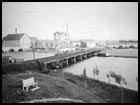
Great Eastern Railway bridge linking Huntingdon East Station to Godmanchester. The bridge was a two track wooden trestle bridge constructed in 1850. The line ran through a cutting in Huntingdon’s Castle Hills.
Neolithic Ceremony 3800BC
The first evidence of human activity seen in the archaeological record can be placed in the fourth millennium BC, the earlier part of the era known as Neolithic. This is regarded as a long period of transition between the Mesolithic, when people relied upon hunting and gathering food as a source of sustenance, and the Bronze Age, when we can recognise the settled agricultural communities.. This change in subsistence strategy was also accompanied by new technologies, particularly the introduction of pottery. It is during this Neolithic period that man made a significant impact on the landscape with major forest clearance and the construction, for the first time, of sizable monuments, including the ceremonial centre at Godmanchester. This startling discovery remains unique. There are many occurrences, both in Britain and Western Europe, which would have been contemporary with it:- earthen long tombs; ‘causewayed enclosures’ formed from concentric ditches and the long avenues known as ‘cursus’, but there is, as yet, nothing to compare with the scale and form of the construction uncovered.
Click images to enlarge
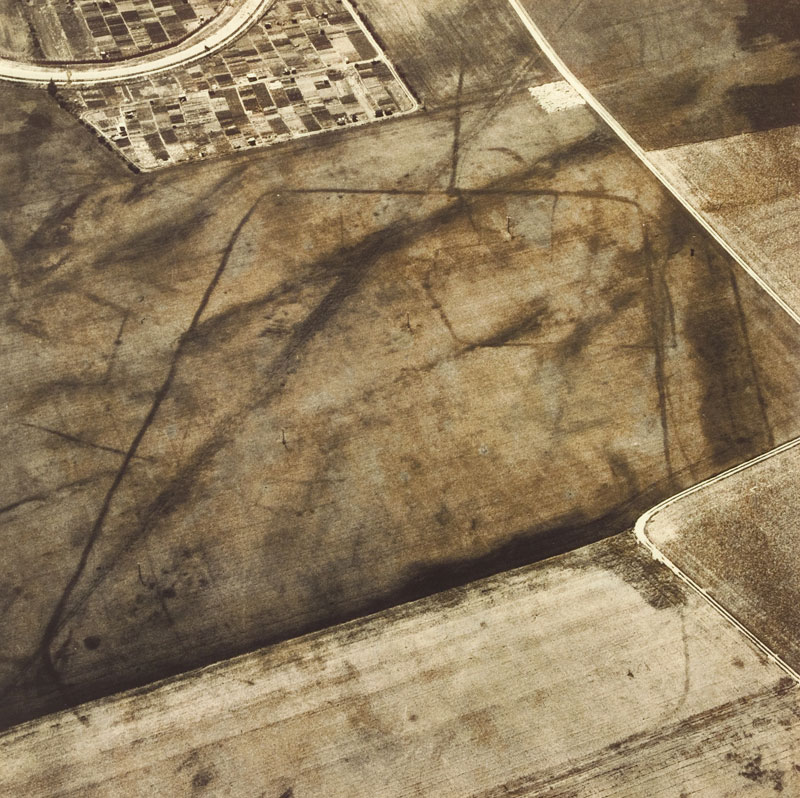 The Neolithic monuments were discovered from this aerial photograph held in Cambridge University. The dark lines, known as crop marks, mark the position of the underlying prehistoric ditches. The fills of these ditches contain a more organic material, and retain more moisture, than the undisturbed gravel. In dry weather the crop over the ditches will remain green whilst surrounding stems ripen earlier and turn yellow, creating the lines so clearly visible from the air.
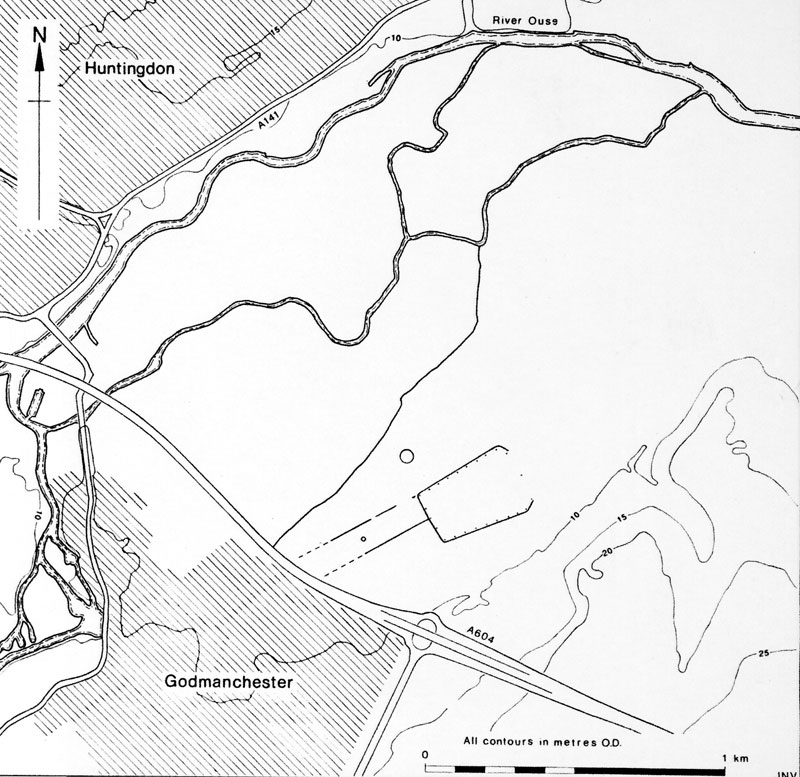 This plan shows the relationship between:- ceremonial centre and cursus; the physical features in the landscape and the later towns We can see the Neolithic monument lie close to the river, a common location for them, and their orientation did not respect the natural lie of the land, which is formed by the hills to the east and the small stream to the west. The parallel ditches which define the long processional way, known as the cursus have been traced as far as the A14 (A604 on plan).
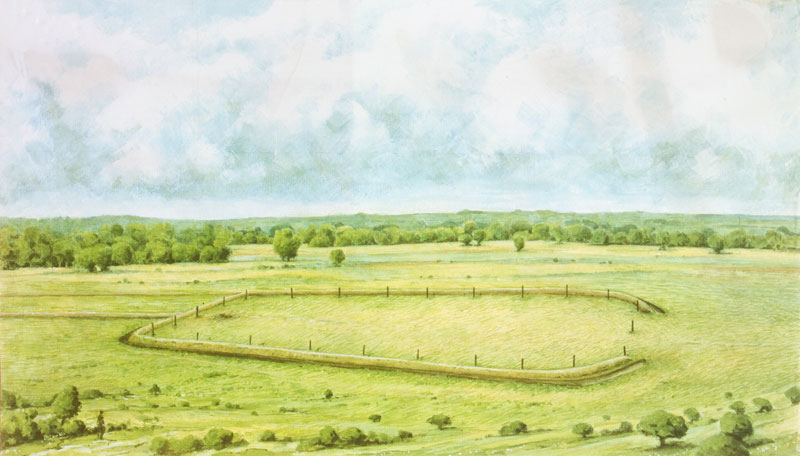 This is a reconstruction of the ‘ceremonial centre’. It was 340m long, enclosed an area of 63,000 sq metres and had an entrance 180m wide at the north-east end. 24 large oak posts, each 60cm diameter, were arranged symmetrically within the 4m wide enclosing ditch and bank. The chronology has been established by the radiocarbon (C14) dating of charcoal from the posts. The ceremonial centre was in use around 1200 years before the erection of the earliest Egyptian pyramids, 1000 years before the construction of the first Stonehenge and nearly 4000 years before the Roman occupation of Britain.
Images and text courtousy English Heritage.
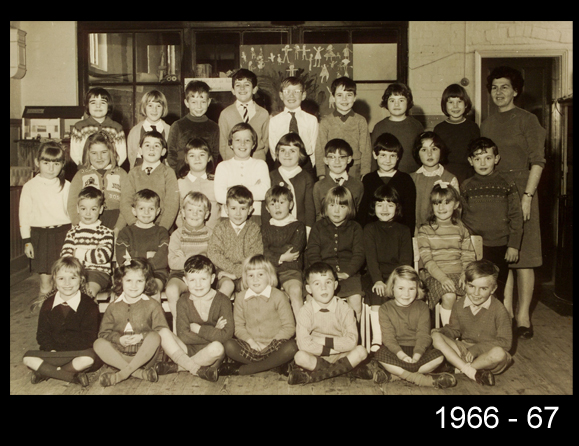
Teaching at St Anne’s Lane School in the 1960’s
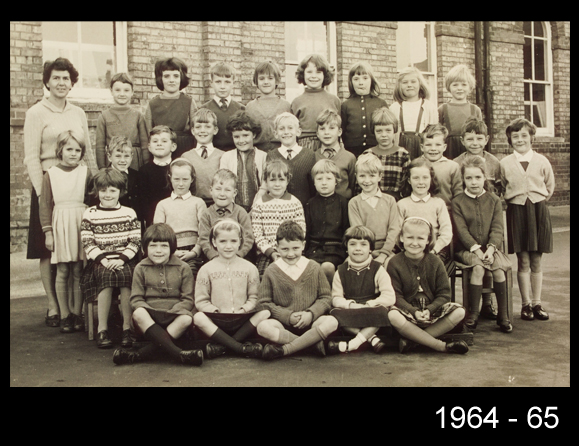 was situated on two different sites. The junior department was at Park Lane and the infants were in St. Anne’s Lane.
 I was to be in charge of the infant dept. and so was based in St. Anne’s Lane. The headmaster was Mr. Reg Lord. He visited the infant dept regularly but day to day running was left to me.
To start with there were three teachers in the infant dept. Mrs. Sawyer taught the reception class, Mrs. Munt taught the 6yr. olds and I taught the 7yr. olds. Later when numbers increased Mrs. Bagenal joined the staff and taught the older reception children and a few of the younger 6yr olds. Children usually started school at the beginning of the term in which they would be five which meant that the reception class started off fairly small but numbers increased each term.
When I started there were about 100 children in total but by the time the dept was moved to Park Lane there were probably 120 to 130.
I have to say that my memories of my time at St. Anne’s Lane are hazy and may not be accurate. The school building was basically one large room divided into spaces for individual classes as necessary. I think this was done by partitions. There were cloakrooms at each end of the building but I don’t think there was a staffroom. The school building was surrounded by a hard surfaced playground which was used for P.E and games as well as at playtime when weather permitted. When it rained the children had to stay indoors.
The school day followed the pattern that was usual for that date. The day started with the calling of the register in each class by the class teacher and great care had to be taken to get the number present and absent right. I was responsible for checking the registers at the end of each term to make sure the numbers added up correctly.
Dinner money was then collected from those who were staying for school lunch. This was followed by assembly which involved the singing of a simple hymn, the reciting of the Lord’s Prayer and any necessary announcements. After this came Scripture, then maths. After the mid-morning break reading and writing activities took place and lasted until lunch time.
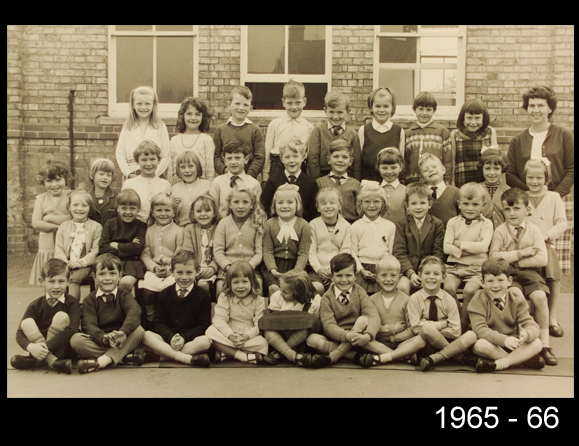
Many children went home for lunch but those who didn’t took it at tables in one of the classrooms. One or two helpers came in to supervise this but a teacher was also always on duty.
On fine days the children played outside after lunch but on wet days they had to be amused indoors. The afternoon was taken up with such subjects as handwork, painting,
nature study and simple history or geography. The day ended usually with story time when the teacher read stories and poetry to the class. There were a number of school’s programmes available on the radio at that time.
With my class I used a poetry programme in which children were encouraged to listen to poems read by different people and to join in at various places. Simple music was also heard in these programmes. There was also broadcast a programme called Music and Movement which involved the children in dancing and expressing themselves to different styles of music. Unfortunately this required space and so was difficult to organise.
While I was at St.Anne’s Lane education pundits began to recommend the teaching of French at an early age. Mr. Lord thought this a good idea and decided that my class should begin to learn French. I was supplied with a set of records to which the children had to listen. They consisted of simple words and phrases which the children had to repeat. The experiment did not last very long.
Math’s teaching for the youngest children involved learning to count and recognise numbers, then to add up and subtract simple numbers and gradually to multiplication and division and more complex operations as the children grew older. They were introduced to money and did practical work involving shopping and adding up bills. Measuring also involved practical work as did weighing. Not only did the children have to learn the multiplication tables from 2 times to 12 times but they also had to learn the money table which began “twelve pence one shilling” and had to know how many inches in a foot etc. much more difficult than the current decimal system.
Reading was taught by mixed methods but with an emphasis on phonics. The Marian Richardson style of handwriting was taught. Although the building was dilapidated and resources limited I think the children were given a good grounding in basic skills.
In July 1967 at the end of the academic year the school closed for good. In September 1967 the infant dept. joined the junior dept at Park Lane School. There were two permanent classrooms attached to the main building in which the 6 and 7 year olds were housed but the 5year olds were accommodated in two temporary classrooms situated in the playground near the entrance to the infant dept.
Queen Elizabeth Grammar School Godmanchester
Queen Elizabeth Grammar School Godmanchester
By Pam Sneath.
The school building sits in the heart of Godmanchester and is passed, often without notice, by many on their way to the Chinese Bridge and the recreation grounds and riverside walks beyond. Others know it well as a community hall where they or their children attend classes, clubs or parties. What is less understood about the building is the role it had for nearly 400 years as the town's grammar school.
The Shorter Oxford English Dictionary defines grammar school as 'a class of schools founded in the 16th century or earlier for the teaching of Latin Grammar'. It seems probable that some form of education had existed in Godmanchester long before the founding of the Queen Elizabeth Grammar School. There is evidence to suppose that a Chantry founded in the 14th century was also used for teaching purposes, but during the reign of Edward VI the endowment lapsed, passing into the hands of the king.
Godmanchester's temple of the Sun
Godmanchester's temple of the Sun
Reproduced with the kind permission of The New Scientist Magazine
Archaeologists digging away amid the gravel pits of Cambridgeshire have discovered what appears to be ancient Europe's most sophisticated astronomical computer
Almost 5000 years ago, people living just outside what is now Godmanchester, near Cambridge, built an impressive monument of banks, ditches and wooden poles covering some 7 hectares. The construction seems to have been designed primarily to predict the major events of the year-long solar cycle and the 19-year lunar cycle.
The complex-which probably functioned as some sort of temple involved with the worship of the Sun and the Moon-consisted of 24 wooden obelisks flanked by more than half a kilometre of banks and ditches arranged in the form of a giant trapezoid. Archaeologists say the site is unique.
Preliminary research has shown that pairs of key obelisks were aligned with all 12 major events in the solar and lunar cycles: the major and minor midsummer and midwinter moonrises and moonsets, and the midsummer and midwinter risings and settings of the Sun. Moreover, the temple faces the point on the ...
To continue reading please see The New Scientist web page
George Cross a Godmanchester hero
The Porch Museum remembers a hero of this town and tells his story once again, so that those who already know about him and those who do not can join together in celebrating an act of bravery.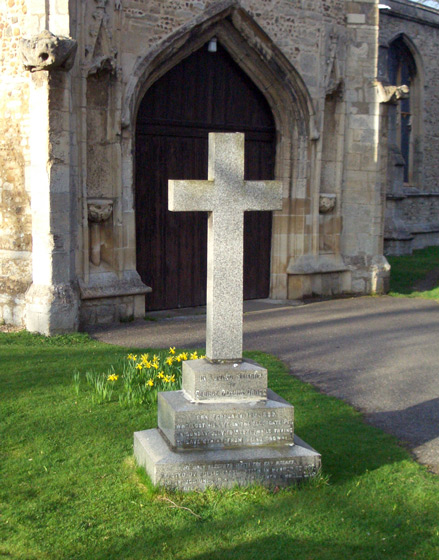
Outside the south porch of St. Mary’s Church stands a prominent granite cross which marks the coming together of the community to show their grief and honour a remarkable young man from an old Godmanchester family. His name was George Cross.
On a summer’s day in 1920, young George Cross, then 21 years old saw a boat overturn on the river, just by the pool near The Island and the sluice gates. He dived in to rescue the young woman passenger and her little eight year old niece, but try as he might – and he was a strong swimmer - they both drowned. George swam hard, then suddenly struggled against the current. He almost reached the little girl, but ran into trouble himself. He was heard to cry out “I’m done” before sinking below the surface. Nobody could really understand why a strong young man who knew the waters so well could have drowned, but some said that the little girl in her panic grabbed his collar and prevented him swimming.
A massive funeral procession for George Cross wound through the town, from St. Ann’s Lane, along The Causeway, then to the church, the coffin followed by the
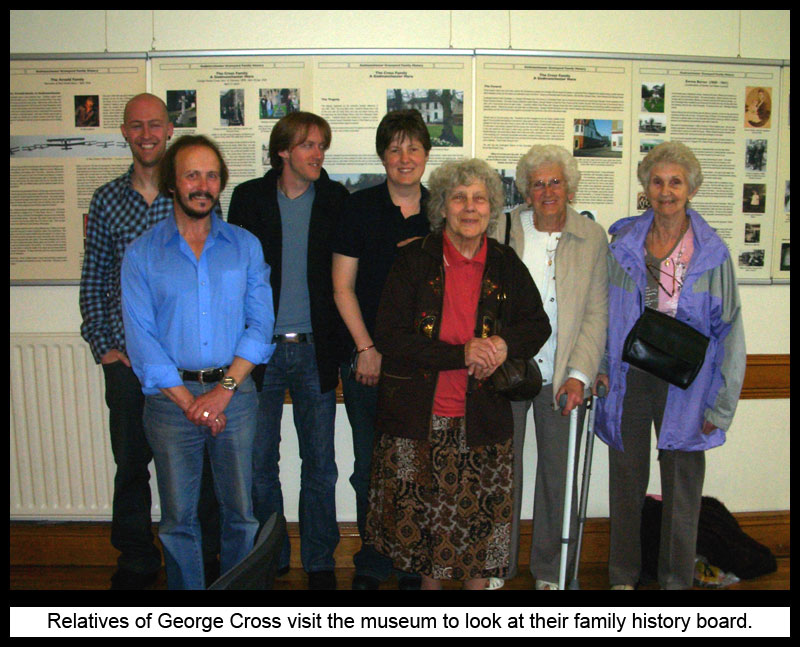
Mayor of Godmanchester and children from the local schools. Crowds filled the graveyard when the church was too full to take any more, and that evening the bell ringers rang a muffled peal. The community came together and funded the memorial cross that still stands today. His story and the story of his family who were well known in the town is a new addition to the family history boards which form part of the museum collection. His father Edward Cross, affectionately known as Nutti, held the position of Mace Bearer from 1919 to 1949 and will be affectionately remembered by older people in Godmanchester.
Kate Hadley.