George Cross a Godmanchester hero
The Porch Museum remembers a hero of this town and tells his story once again, so that those who already know about him and those who do not can join together in celebrating an act of bravery.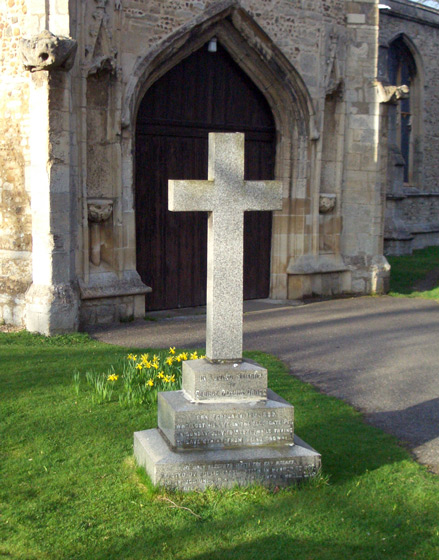
Outside the south porch of St. Mary’s Church stands a prominent granite cross which marks the coming together of the community to show their grief and honour a remarkable young man from an old Godmanchester family. His name was George Cross.
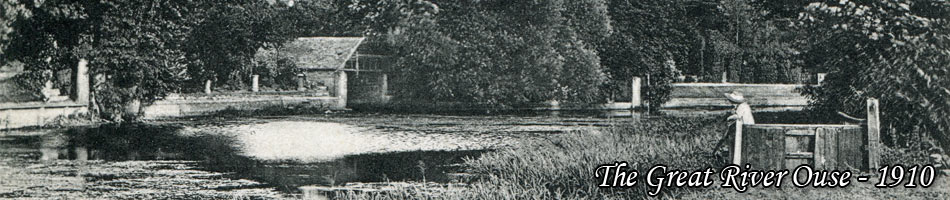
On a summer’s day in 1920, young George Cross, then 21 years old saw a boat overturn on the river, just by the pool near The Island and the sluice gates. He dived in to rescue the young woman passenger and her little eight year old niece, but try as he might – and he was a strong swimmer - they both drowned. George swam hard, then suddenly struggled against the current. He almost reached the little girl, but ran into trouble himself. He was heard to cry out “I’m done” before sinking below the surface. Nobody could really understand why a strong young man who knew the waters so well could have drowned, but some said that the little girl in her panic grabbed his collar and prevented him swimming.
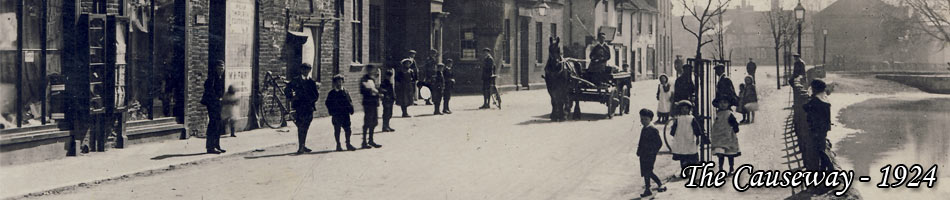
A massive funeral procession for George Cross wound through the town, from St. Ann’s Lane, along The Causeway, then to the church, the coffin followed by the
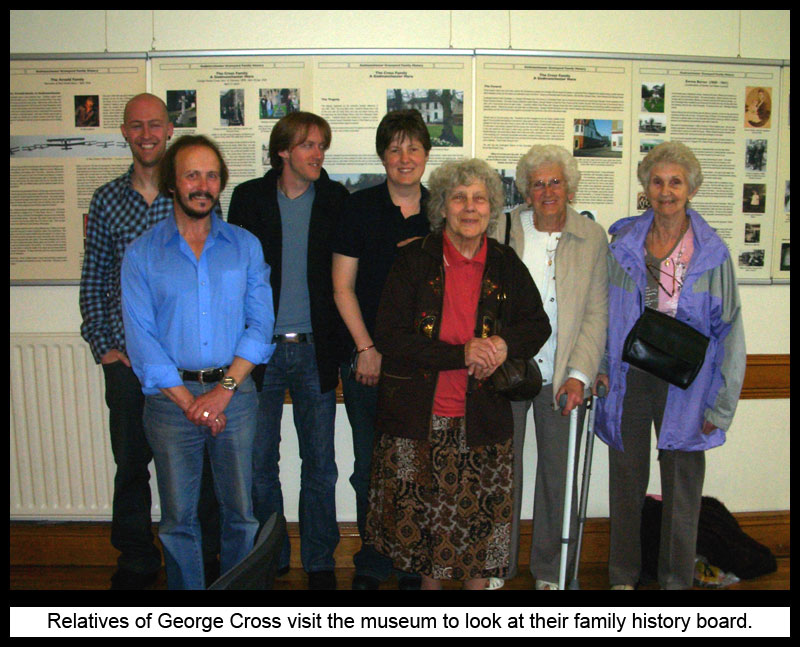
Mayor of Godmanchester and children from the local schools. Crowds filled the graveyard when the church was too full to take any more, and that evening the bell ringers rang a muffled peal. The community came together and funded the memorial cross that still stands today. His story and the story of his family who were well known in the town is a new addition to the family history boards which form part of the museum collection. His father Edward Cross, affectionately known as Nutti, held the position of Mace Bearer from 1919 to 1949 and will be affectionately remembered by older people in Godmanchester.
Kate Hadley.
The Chinese Bridge
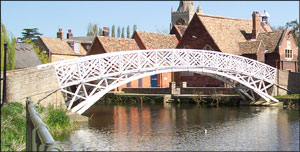
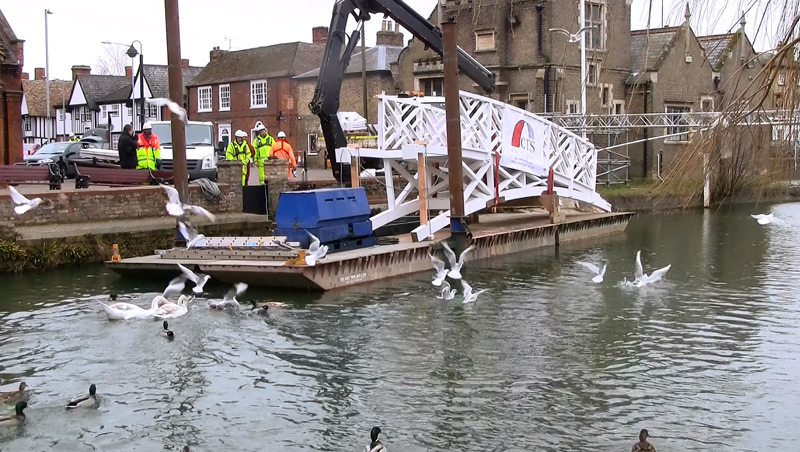
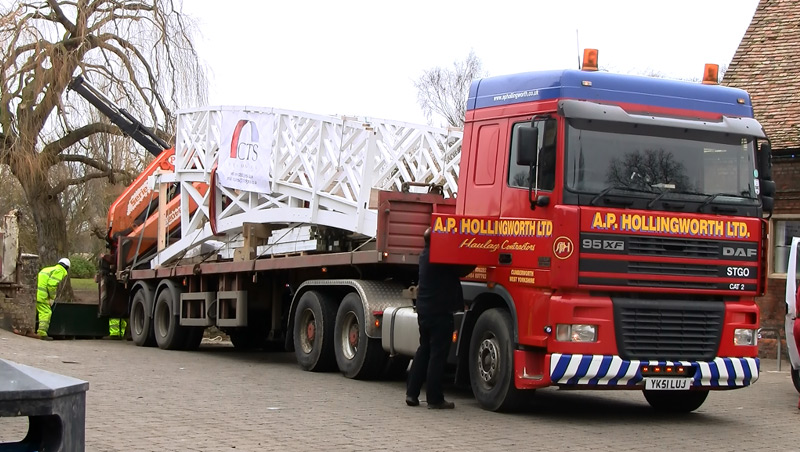
The Chinese Bridge is a landmark of our town and has stood since 1827. The bridge is now in its forth generation. Originally designed and constructed by an Irish Architect 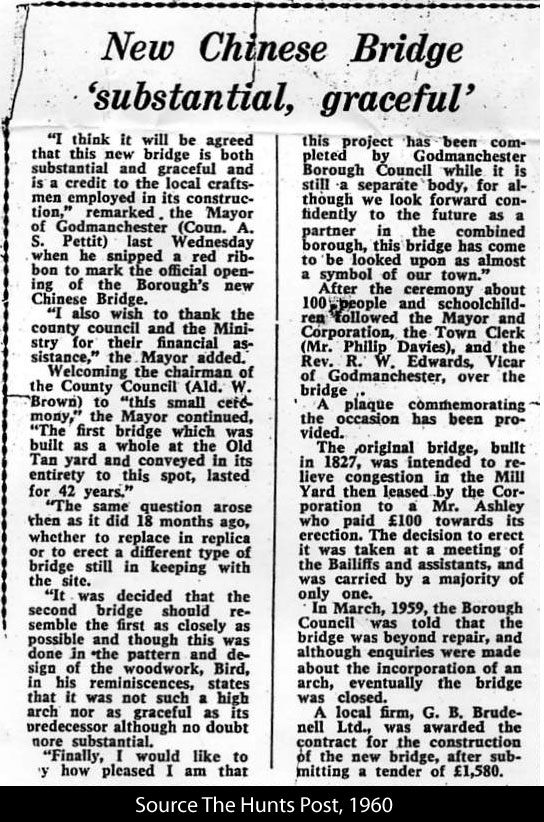 by the name of James Gallier, rebuilt in the 1860s and again rebuilt in 1960 with a replica by G.B. Brudenall Ltd of Godmanchester for the sum of £1,580, on behalf of the council (Select the image on the right for the newspaper article) and again replaced with a replica 50 years later by CTS Bridges, Shepley, Huddersfield.
The design of the bridge was influenced by the popular 18th Century style on Chinoiserie, a French term, indicating “Chinese-esque” which was a recurring theme throughout Europe and is a mixture of Eastern and Western styles for both decoration and shape.
The original Architect Gallier, did not come to Godmanchester for the sole purpose of designing and erecting the Chinese Bridge. He was originally commissioned to be “Clark of the Works" and oversee the construction of Huntingdon’s Prison, which can still be found at St-Peters road today. From Galliers’ autobiography he describes his time in Huntingdon and Godmanchester with joy and great sadness. The following is a quote from his autobiography:
|
“In 1826 I was flavoured a letter from Mr. Wilkins saying that, if I still had a desire to be engaged as a clerk of the works, he had something which might suit me; and if I could meet him in the town of Huntingdon, he could there point out the duties I should have to perform if I entered into the engagement. I attended at the appointed time and place, and found he was about to build a prison for the county of Huntingdon.
Having examined into my fitness for the situation, he engaged me at a salary of four pounds a week, to take charge of the plans, and to see that the work was performed by the contractor in accordance with the drawings and specification.
I was delighted with my new situation, being the first appointment I ever had that held out a prospect of advancing my position in life; so, having returned to London and put my affairs in order, I took my family down to Huntingdon and soon had everything put into proper working condition.
In a year after my marriage our first child was born, which was a boy, but he died early in infancy; our second was a girl, who lived to the age of four years our third was my dear James, the only one left now; he was born in Huntingdon on the 25th September, 1827, and was Christened in the picturesque old church of that town; our forth was a girl, born after our return to London, but died in early childhood.
My next neighbour at Huntingdon was Mr. Robert Carruthers, a literary man, who carried on the business of a book binder at the same time with the management of the county school. He published a history of Huntingdon and other works; and, having afterwards removed to Scotland, became editor and ultimately the proprietor of the “Inverness Courier” which he conducted with great ability for many years. This excellent man was of much service to me, he directed me to a course on reading and put me in the way of obtaining books. I became a member of a debating society and a social book club; I also joined a Masonic lodge, and, during my two years of my stay at Huntingdon, my knowledge of life and the ways of Society became much enlarged.
I made a small wooden model of the gaol, so constructed that the roofs and upper storeys could be separately lifted up to show the interior divisions of all the yards , passages, rooms, and cells throughout the building this I sent to Mr. Wilkins, who was highly pleased with it.
I was frequently called on by persons of the town and neighbourhood of Huntingdon to give plans for alterations to their houses; I also planned and superintended the erection of a small wooden bridge, of original deign, across a branch of the River Ouse at Godmanchester, and I now began to fancy myself a person of some little importance. To understand the degree of elation I at that time felt, a man must have started in life as I had done, on nearly the lowest rung of the social ladder, and have toiled his way painfully upward, even to the humble position I had then attained." |
After completing his work in Huntingdon James Gallier returned to London and started work on the redevelopment of the Grosvenor Estate in Mayfair. Unfortunately Gallier became bankrupt and emigrated to America in 1832 with his family. Gallier had a successful career in America, his noteable achievements, which are now National Historic Landmarks include Gallier Hall, Pontalba Buildings, Government Street Presbyterian Church, the Leeds Davies Building, The Second Christ Church Catherdral, Barton Academy and Belle Helene.
James Gallier died on October 1866 during a trip on the steamer Evening Star, from New York to New Orleans which sank during a Hurricain. His second wife, Catherine Robinson died with him.
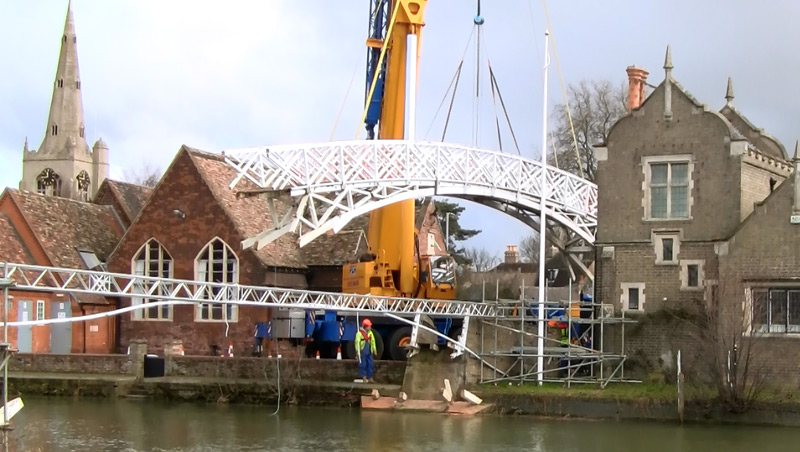
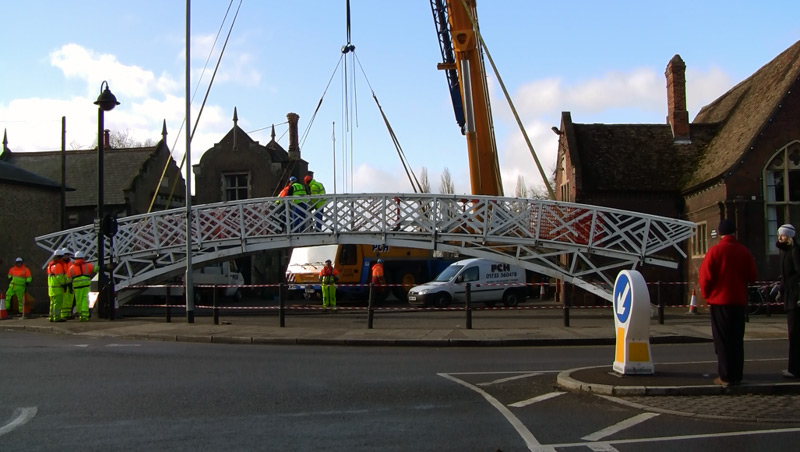
To record the replacement of the Chinese Bridge in 2010, the Porch Museum decided to record the removal and replacement of the bridge. These few days filming have now been put together into a historical DVD. The film also contains interviews and new details on James Gallier from Godmanchesters best liked historian Ken Sneath. We further investigate Godmanchesters second bridge linking Island Hall with its Island, the story is told by Christopher Vane Percy.
To purchase this DVD please visit the Godmanchester Porch Museum Shop for further information.
The following links are extracts from the DVD showing interviews with David Brown and Christopher Vane Percy.
Click the image below for a short gallery of Chinese Bridge Photos


A Japanese connection with Godmanchester
By Caroline Kesseler
Research in the Huntingdon Archives has revealed that in the late 19th Century a Godmanchester family became closely acquainted with one from Japan - an unusual occurrence in the town at this time.
On the 29th of November 1886, Sarah Elizabeth Halstead of Cambridge Street Godmanchester married John Seyama of High Street Huntingdon. She was 21 and he was 24. Their marriage certificate shows that the marriage took place in the Huntingdon Register Office and that both partners were single at the time. John’s occupation was given as butler, and his father was recorded as Mioriga Seyama a gentleman. Sarah’s father was recorded as John Halstead a gardener who had died at some time prior to the wedding.
John Seyama appears to have arrived in Britain from Japan at some time between 1871 and 1881. The population census of 1881 shows that he was living in the household of Mr Isaac Bernard in the High Street in Huntingdon and was recorded as Shisastic Seyama, a 21 year old domestic servant born in Japan. It is quite likely that he took the name of John at the behest of his employer. It appears that Mr Bernard was probably fairly wealthy, as the house he lived in is that known as Cromwell House in Huntingdon High Street. He had been a Captain for the ‘Peninsular & Oriental Steam Navigation Company’ before his retirement, which is possibly how he met John. It is thought by John’s descendants that he had been a journalist in Japan and was permanently exiled after having written something deemed politically incorrect by the authorities there.
The 1881 census also shows that Sarah Elizabeth was living in Cambridge Road Godmanchester. She was recorded as being the daughter of George and Mary Thackray. George was a dairyman who had been born in the town, whilst his wife Mary had been born in Upton. Sarah was recorded as having been born in Godmanchester c.1866 and was a general domestic servant. John and Sarah’s marriage certificate however stated her maiden name was Halstead, and indeed the 1871 census reveals at that time she had been recorded as Sarah E.Halstead living with George and Mary Thackray in Cambridge Street as George’s daughter in law. At this period of time a ‘daughter in law’ was often the term used for step-daughter.
Further research revealed that Sarah’s mother married George Thackray 22nd February 1871 in Huntingdon Register Office. George was a bachelor and Mary was a widow. Her surname at the time was recorded as Halstead but her father, a Chelsea Pensioner, was recorded as George Mackness, revealing that Mackness was her maiden name. George’s father was recorded as Richard Thackray a farmer. Both fathers were deceased at the time of George and Mary’s marriage. It would seem that Sarah was a daughter from Mary’s previous marriage to a Mr Halstead.
There still remains some uncertainty over the exact parentage for Sarah however. Her birth was registered in Huntingdon 17th May 1865 giving her birth date as 10th May the same year. However she was baptised over three years later in St Mary’s Church Godmanchester on 21st June 1868. Her birth registration states her mother was Mary Halstead nee Mackness of Godmanchester, but there is no father recorded, which does suggest illegitimacy. The baptism record in the parish register however records her father as John Holstad who’s occupation was recorded as gardener and then crossed out and replaced with Dragoon Guard. Extensive research has so far revealed no record of marriage for Sarah’s mother to John Halstead, or any record of his death.
It appears that John and Sarah Seyama’s domestic arrangements were greatly influenced by John’s work. Various records show them as living either in Huntingdon or Godmanchester. The 1891 census shows that John is living at Cromwell House Huntingdon as the butler, whilst Sarah and a son were living with George and Mary Thackray in Cambridge Street Godmanchester. By this time Sarah had actually given birth to two children – Ethel Mary had been born in January 1887 and William Moregie in August 1888. Both were baptized in St.Mary’s Godmanchester, but unfortunately Ethel Mary had died aged just 5 months and is buried in the churchyard. Also in the house were George and Mary’s children – Mary and Richard Thackray aged 19 and 16 respectively.
In 1892 John Seyama became a Naturalised British Citizen and the couple went on to have 3 further children – Cyrilla O’Tsura born March 1893, baptised in Godmanchester and Isaac Olive Yokichi and Cara Mayo, both baptised at All Saints in Huntingdon in 1895 and 1899 respectively. Cara Mayo died aged 2 in 1901 and is buried in Godmanchester. There do not appear to be any monuments to mark the resting place of Ethel and Cara.
This photograph (Click to Enlarge) taken by local photographers Maddison & Hinde, shows John and Sarah with their three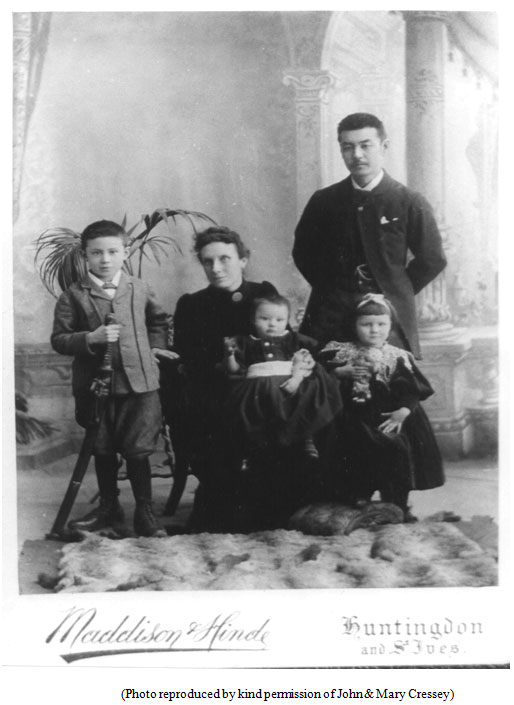 surviving children – William holding the Japanese sword, Isaac on his mother’s lap and Cyrilla holding a Japanese doll. The sword is understood by the family’s descendants to have been sent to John by his family in Japan, and it is thought that the doll was probably also a gift. This photograph was most likely taken between 1896 when the sword was photographed in Japan prior to it being sent, and 1899 when Cara Mayo was born as she is not in the picture.
Sarah is known to have died in January 1900 and is buried in Priory Road Cemetery in Huntingdon. Her unusual headstone is formed from rough hewn stone with a flat panel at the front bearing an inscription. Above the inscription is a symbol known as a ‘Right Handed Triple Tomoe’ or ‘Mitsu’ which is associated with Shinto mythology.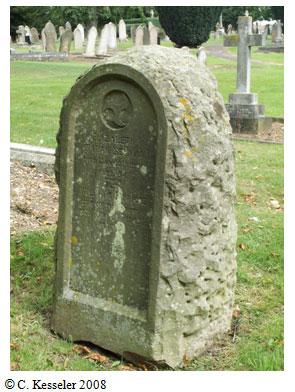
The 1901 census shows John Seyama, now a widower, living at Cromwell House, Huntingdon whilst the children are living nearby at 64 Great Northern Street in the care of a housekeeper.
Unfortunately John was to lose another of his children, for on 27th August 1905, William died at the age of seventeen. He was buried with his mother and commemorated on the same headstone.
So John was left with the two remaining children Cyrilla O’Tsura and Isaac Oliver. The 1911 census shows John still living at Cromwell house whilst Cyrilla being eighteen and a student teacher was caring for Isaac (aged fifteen and still at school) and living close by at 13 Great Northern Street.
Cyrilla went on to marry into the Cressey family in 1918 and eventually emigrated to America.
Isaac Oliver trained as a gardener working briefly at Workson Park in Slough and Tilney Hall near Basingstoke, before moving to Tredegar Park in Monmouthshire South Wales in September 1913. He began work in the hothouses, and surviving WW1 when he fought with the South Wales Borderers and was awarded the Romanian Medal for Valour, he was to remain a gardener at the house until three weeks before his death in 1973. He had married an estate carpenter’s sister Beatrice Ann Buchanan in 1922 and had a daughter Mary Janet who appears to have died a spinster in Monmouthshire in 2000.
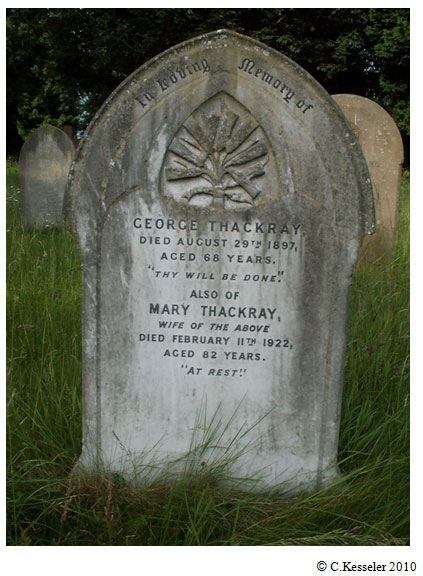 Sarah Elizabeth’s mother and stepfather remained residents of Godmanchester. George Thackray died in 1897 and the 1901 shows Mary, a widow, still living in Cambridge Street Godmanchester with her unmarried children Richard and Mary. She remained a widow and died in1922. Both George and Mary are buried in St Mary’s churchyard and have a memorial stone marking their plot.
John Seyama died in Huntingdon on the 8th of May 1918 aged 61 years, and he is buried in Priory Road Cemetery. His headstone also bears a Shinto symbol.
What's new for 2011
We will be showing two special films the museum has produced.
'Children of Godmanchester' .
Inspired by an old Pathe Pictorial film, shot in West Street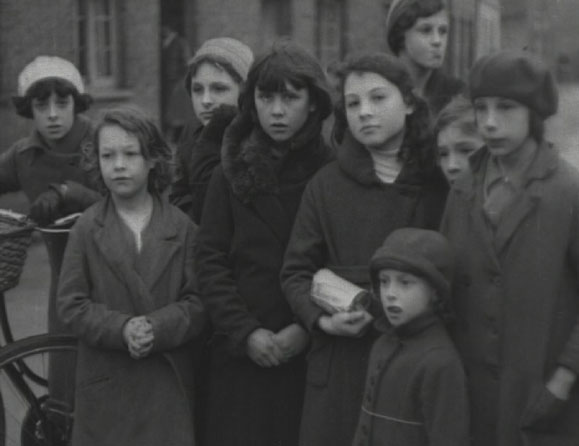 Godmanchester in February 1934, we turned detective and found either the children who were shown on that film, or their families. All are interviewed on the film, accompanied by a young local composer's arrangement of music based on Gracie Fields songs - she was a hit here in the 30s and interviewed in the Hunts Post at the time the Pathe film was shot.
Godmanchester to Quebec - A Culinary Connection
By Caroline Kesseler
As secretary & bookstall manager for the Huntingdonshire Family History Society, I receive many enquiries, and
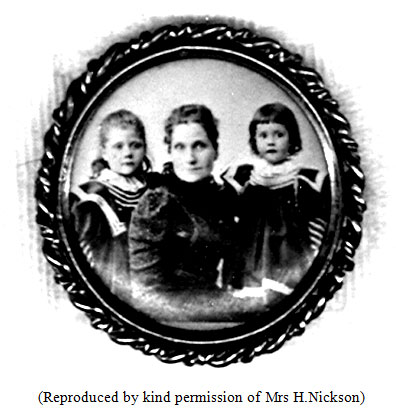
for the most part I find them very interesting, and try to help the enquirer find a new way forward in their research. Occasionally the enquiry intrigues me, and I cannot help delving a little deeper to find out more about the family involved, which was the case when I received an email from Mrs Heather Nickson, living on Vancouver Island, British Columbia, Canada, stating that her family were in possession of two recipe books written by her Great Grandmother, Naomi Nightingale, with one having an entry marked “Island Hall, November 21st 81” with a recipe for ‘Venus Pudding’
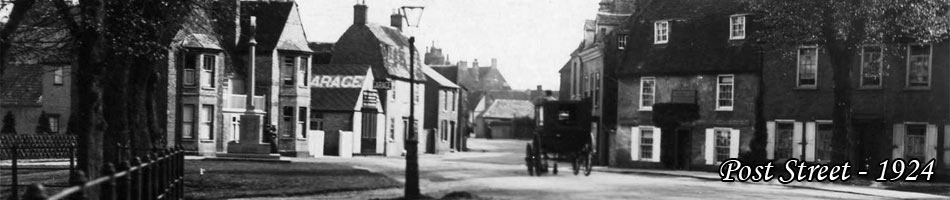
Many of those who have connections with Godmanchester will know that there is a large Georgian mansion called Island Hall in Post Street. The ‘Island’ lies in the River Ouse which runs behind the house. It is quite small, and is connected to the hall gardens by a wooden Chinese style bridge.
The email stated that Naomi was listed on the 1881 Census as being the cook at Island Hall, and that the head of household at the time was a widow, Phillippa Baumgartner. A quick check with the original census pages confirmed that this was indeed the case:
Post Street, Godmanchester, Huntingdonshire
Phillippa Baumgartner, head, W, 89, Widow of M.D., born: Cambs. Milton
Robt J.Baumgartner, son, married, 67, Lieut.General Army Officer unattached, born: Hunts.Godmanchester
Helen Baumgartner, daughter in law, 46, born: Ireland
Emma J. Baumgartner, daughter, unmarried, 51, born: Switzerland, British Subject
Helen P. Baumgartner, grand daughter, unmarried, 19, born: East Indies
Violet J. Baumgartner, grand daughter, unmarried, 17, born: East Indies
Ethel N. Baumgartner, grand daughter, 10, born: Ireland
Grace E. Baumgartner, grand daughter, 8, born: Ireland
Naomi Nightingale, servant, unmarried, 25, cook, domestic servant, born: Cambs. Girton
Rebecca Sanderson, servant, unmarried, 34, ladies maid, born: Derbyshire, Derby
Mary Evers, servant, widow, 59, nurse, born: North Wales
Catherine Webster, servant, unmarried, 27, parlour maid, born: Hunts. St Ives
Emily Chandler, servant, unmarried, 27, housemaid, born: Hunts. Godmanchester
Emma Scott, servant, unmarried, 18, kitchen maid, born: Hunts, Godmanchester
The Baumgartner’s were a wealthy and influential family, and as can be seen from the above census entries, had links with many places, both in the British Isles and abroad. Naomi Nightingale’s life appears to have been greatly influenced by working for the wealthy Baumgartner family, and the connections they had with other local wealthy landowners. According to research by her Gt. Grandaughters , it is thought she may have worked for the wealthy Wentworth/Fitzwilliam family c.1883, at their estate ‘Coollattin Park’ in County Wicklow, Ireland., as there are recipes with notations ‘Coollatin’ and ‘Coollatin Park 1883’ in the books.
One of the recipes in the book is for ‘Milton Pudding’ and has a notation stating ‘Mrs Whitney – Alwalton’ The 1881 Census shows that Mrs Whitney was the housekeeper at Alwalton Hall near Peterborough, which I believe belonged to the same Fitzwilliam family. In January 1887, whilst in Ireland, and working on the Wells Estate, Co.Wexford, which was also linked to the Fitzwilliams, Naomi married Samuel Henry McConnell and in the same year emigrated to Montreal in Quebec, Canada, where they ran a boarding house for young Irishmen. Naomi and Samuel’s daughter Helen (born Quebec, January 1893) was the Grandmother of Mrs Nickson.
Photograph of a brooch showing Naomi in the centre, with daughters: Helen Ruth (on left of photograph) & Elizabeth Kathleen.
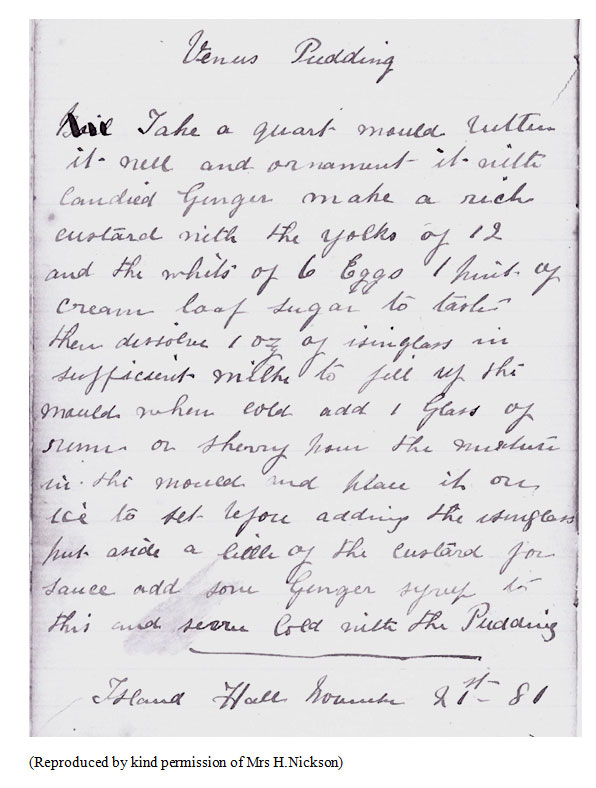 |
TRANSCRIPT OF RECIPE
Venus Pudding
Take a quart mould. Butter it well and ornament it with candied Ginger. Make a rich custard with the yolks of 12 and the whites of 6 eggs, 1 pint of cream, loaf sugar to taste then dissolve 1 oz of isinglass in sufficient milk to fill up the mould. When cold add 1 glass of rum or sherry. Pour the mixture in the mould and place it on ice to set. Before adding the isinglass put aside a little of the custard for sauce. Add some Ginger syrup to this and serve cold with the pudding.
Island Hall November 21st – 81
The recipe books also contained a recipe for sponge pudding, with a note ‘Island Hall June 22nd 1881’ |
The Bridge magazine (2010)
Among many new and exciting offerings this year, which include a film of remarkable past memories from an elder of Godmanchester, Neville Markham, the Porch Museum remembers a hero of this town and tells his story once again, so that those who already know about him and those who do not, can join together in celebrating an act of bravery.
Outside the south porch of St. Mary’s Church stands a prominent granite cross which marks the coming together of the community to show their grief and honour a remarkable young man from an old Godmanchester family. His name was George Cross.
On a summer’s day in 1920, young George Cross, then 21 years old saw a boat overturn on the river, just by the pool near The Island and the sluice gates. He dived in to rescue the young woman passenger and her little eight year old niece, but try as he might – and he was a strong swimmer - they both drowned. George swam hard, then suddenly struggled against the current. He almost reached the little girl, but ran into trouble himself. He was heard to cry out “I’m done” before sinking below the surface. Nobody could really understand why a strong young man who knew the waters so well could have drowned, but some said that the little girl in her panic grabbed his collar and prevented him swimming.
A massive funeral procession for George Cross wound through the town, from St. Anne’s Lane, along The Causeway, then to the church, the coffin followed by the Mayor of Godmanchester and children from the local schools. Crowds filled the graveyard when the church was too full to take any more, and that evening the bell ringers rang a muffled peal. The community came together and funded the memorial cross that still stands today. His story and the story of his family who were well known in the town will be a new addition to the family history boards which form part of the museum collection. His father Edward Cross, affectionately known as Nutti, held the position of Mace Bearer from 1919 to 1949 and will be affectionately remembered by older people in Godmanchester.
The Neville Markham film will stun both younger and older members of the community, with his photographic memory of life here in the early part of the 20th century, so very different from today. Born before the First World War, only thirteen years after the death of Queen Victoria, his early life was in a town that was still more or less on Victorian. We are lucky to have this exceptionally rare testimony and vivid account of a way of life long gone.
The Porch Museum is making available to purchase, on CD a facsimile of the Queen Elizabeth’s Grammar School Pence Book. This book is unique and records attendance at the school between 1850 and 1855 at a time when pupils were asked to pay a subscription of 2d a week. With the majority of Godmanchester men employed as farm labourers earning very little money to support their families, managing to find the 2d for their child’s education was not always possible and entries can be seen where only ½d was being paid. This CD is invaluable for those people interested in genealogy or Godmanchester’s social history, you can look up familiar names from families who live here today, or your own family and find out if your great great grandfather was a regular attender at school. The CD contains the entire register of 19 pages.
New and rare pictures will also be available of the brave and extraordinary Hunts Cycling Battalions, the county’s territorial regiment from around the time of the Great war, 1914-18. So many local men joined up that this exhibition always draws particular interest in Godmanchester and indeed from the rest of the country.
And of course there is a chance to see relics of the town’s ancient Roman past. This year we have added a display detailing the history of Durovigutum, the town constructed by the Romans here. It was burned at the time of Boudica’s revolt against Roman rule. The display looks at public buildings, including the second largest Mansion found in Britain and a temple to the Romano-British God Abandinus, who seems to have been unique to the town.